Your documents in. Proven readiness out.
Upload what your team already has. Mentor126 builds the course, mentors every person through it one to one, and grades them on work they actually did.
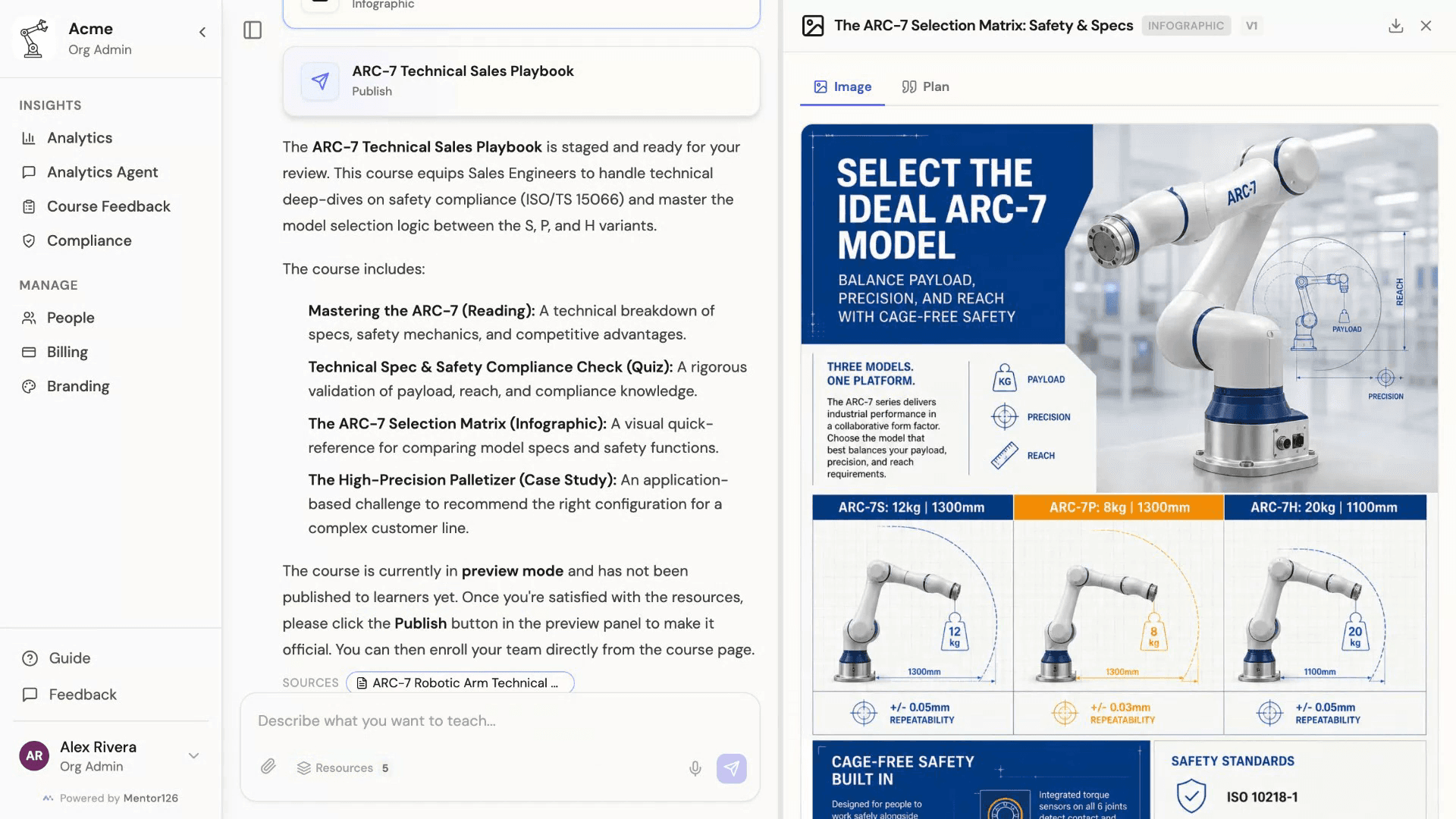
Your first course ships in 15 minutes, from documents you already have.
No course authoring tool. No instructional designer. You describe what your team needs to know, and the Creator writes it from your sources.

Bring what you already have
PDFs, decks, docs, and spreadsheets. Upload them directly or connect Google Drive or OneDrive. Everything is indexed so the Creator can quote it.
Grounded in your documents
Generated lessons cite the file they came from, and when two of your own documents contradict each other it stops and flags the collision instead of picking a winner.
Your methodology, applied
Attach your sales playbook to a job role and it shapes what gets built for that role: the practice scenarios, the rubric wording, the worked examples. Seven common frameworks are built in, or upload your own.
A Knowledge Base that outlives the course
For topics that keep changing, keep one living document synthesized from all your sources, and rebuild courses from it as it moves.
Publish to a person, a role, or everyone
Assign by job role and future joiners get the training automatically, without anyone remembering to do it.
Editable everywhere
Every lesson can be rewritten in conversation before you publish, and an edit that cannot be verified against your sources is flagged rather than quietly accepted.
One topic, any format
You do not have to build it alone
Send us the material you already train on and we build the first course with you on a call. You see it work on your own content instead of learning a tool first. Most teams take it from there after one session.
Everyone gets a Mentor. Not a progress bar.
The learner opens a conversation, not a course player. The Mentor presents the next lesson, answers mid-lesson questions out of your own documents with the citation attached, and works through a mistake with them instead of just marking it wrong.
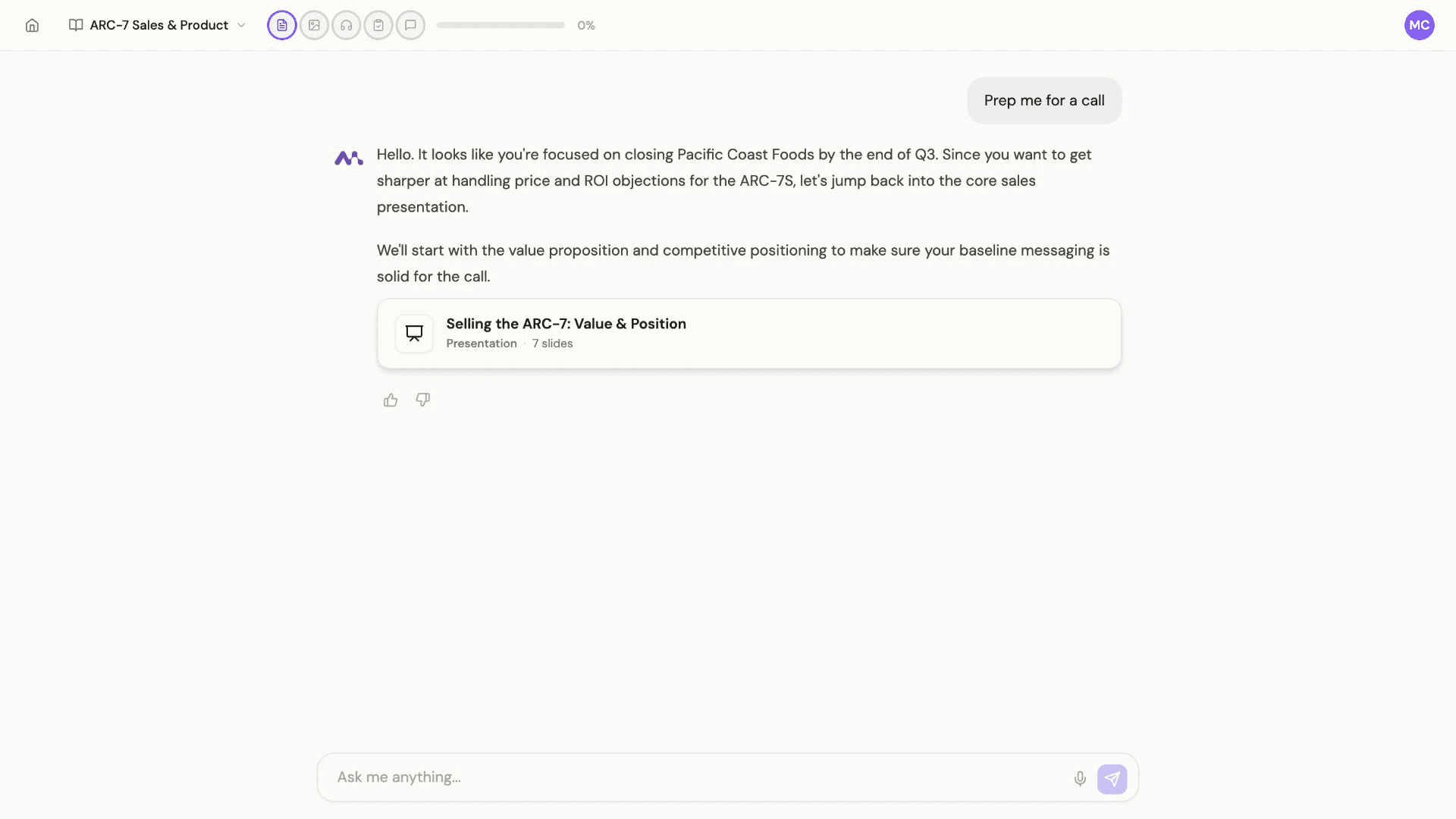
It knows what they already know
Mentor126 keeps a picture of what each person has proven and skips what they have already mastered. Nobody sits through a lesson they could teach.
In their language
Lessons and the interface follow each learner, so one course serves every region.
Nothing to remember to log into
Most enablement tools get bought and never opened. There is no portal here. The training arrives as a conversation, picks up where the person left off, and you can see who actually engaged rather than guessing.
- Picks up where they left off, days later
- Works on a phone between shifts
- Never grades in the chat, so asking is always safe
Practice out loud, before it counts
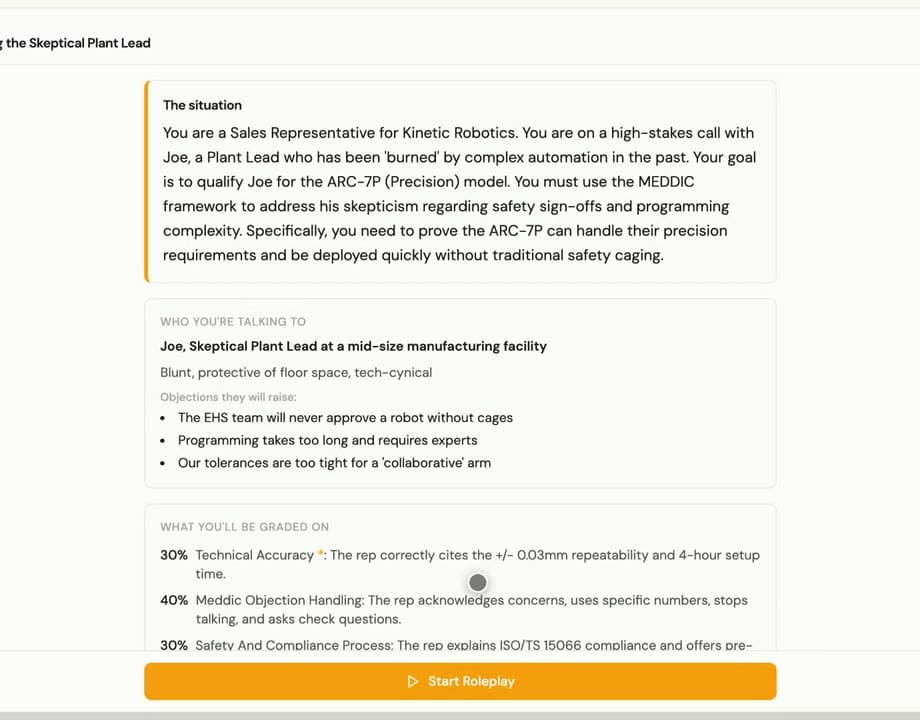
Live voice roleplay against an AI persona for anything conversational: objection handling, difficult feedback, an incident call. They talk, it answers back in voice, and the whole exchange is graded against a rubric afterward.
- Two-way voice, not a chatbot transcript
- Difficulty ratchets up rep by rep
- Graded on what they actually said
- Replay the transcript alongside the score
100% completion, 0% confidence is over.
Completion is not evidence. Mentor126 scores people on work they actually produced, and every score links back to what they said and the rubric line it was judged on.
| What you want to know | Your LMS today | Mentor126 |
|---|---|---|
| Did they finish it? | Yes. That is the only thing it tracks. | Yes, and finishing is not what we report on. |
| Can they actually do it? | A multiple choice score, taken with the tab open next to the answers. | A rubric-graded case study, written answer, or live conversation. |
| Why did they get that score? | Right or wrong count. Nothing behind it. | Sub-scores per rubric dimension, next to what they actually said. |
| Which lesson is failing people? | Run a survey and hope somebody answers. | Failures are grouped by cause and surfaced to whoever wrote the lesson. |
| Who is confidently wrong? | No signal at all. | Captured directly, because certainty is asked for alongside the answer. |
Seven ways to prove it
Pick the one that matches the work. Four are graded the moment the learner finishes. Three are judged against a rubric written from your sources.
Quiz
Whether the facts stuck.
Confidence Quiz
The dangerous answer: confident and wrong.
Faded Worked Example
Whether they can finish the work with the scaffolding removed.
Branching Scenario
Judgment under consequences, one decision at a time.
Case Study
Applied reasoning on a realistic situation.
Minute Paper
Whether they can explain it in their own words.
Live Roleplay
What they actually say out loud, under pressure.
The receipts
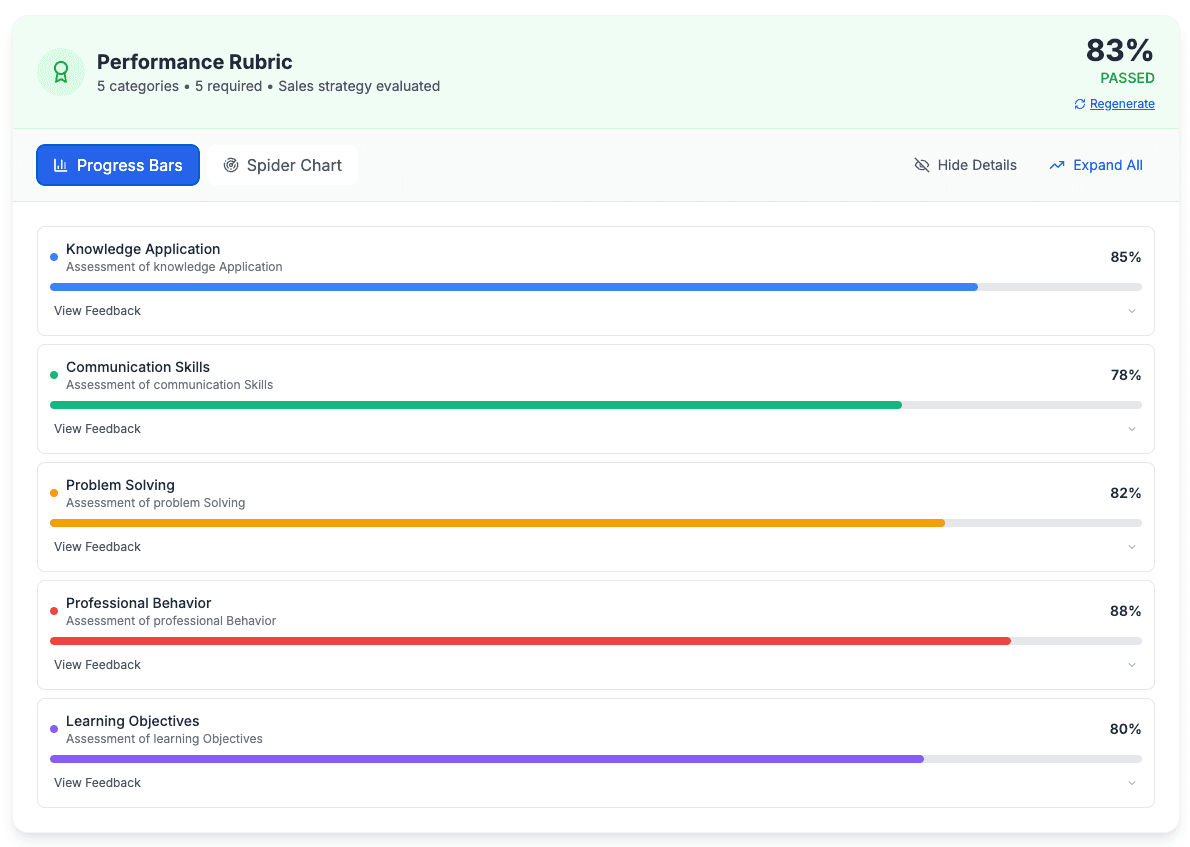
Open any score and you see the sub-scores behind it, the learner's actual answer, and the rubric line each judgment came from. When someone asks whether a person is ready, you have something to show them.
- Sub-scores per rubric dimension, not one opaque number
- The learner's own words, kept alongside the grade
- Grading judged against your sources, not general knowledge
Confident and wrong
The Confidence Quiz captures how sure someone was, not just whether they were right. The people who are certain and mistaken are the ones who cost you money.
Ask your data
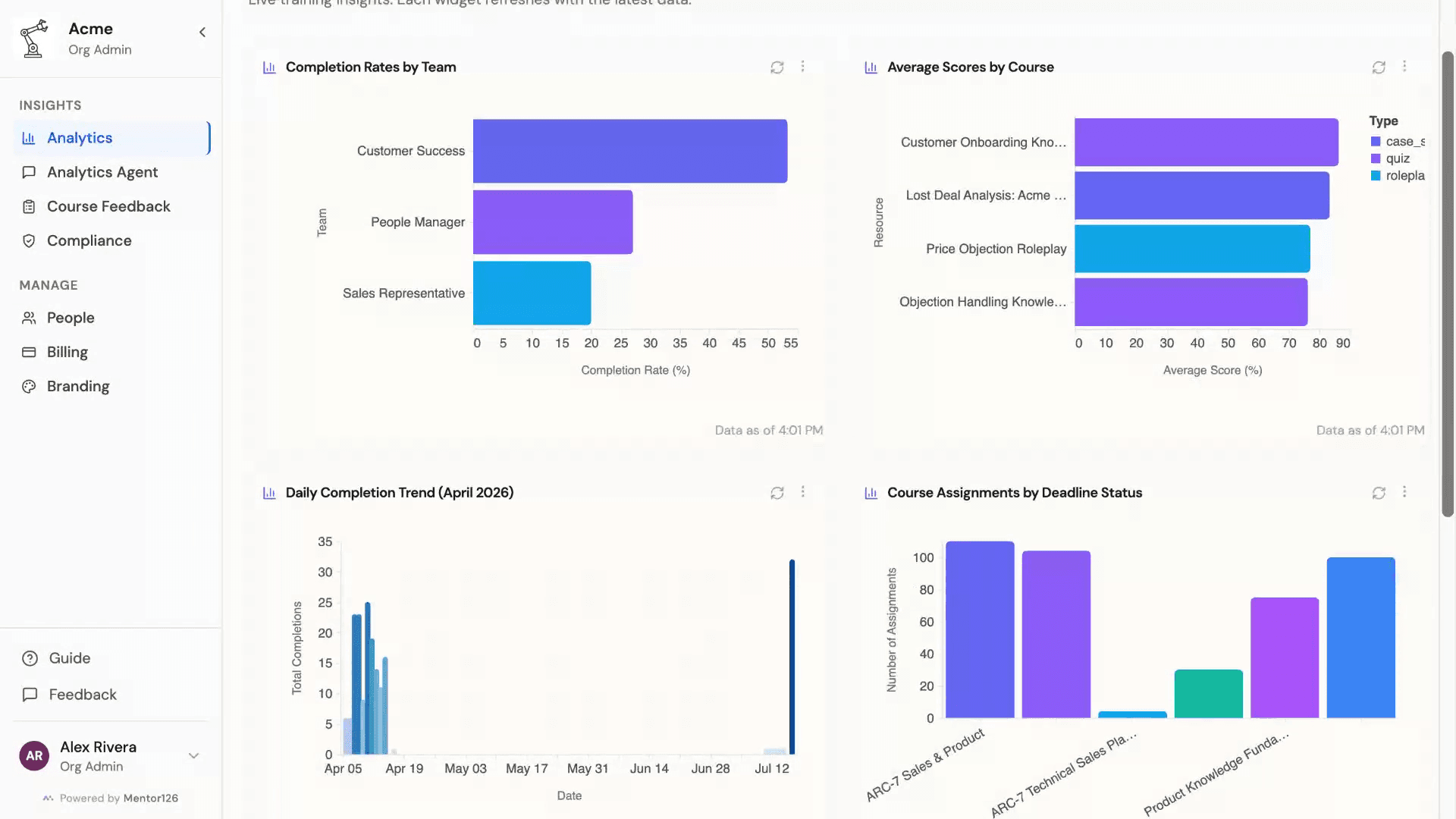
Ask who is at risk in EMEA support in plain language. Get a chart back, and pin it to a dashboard that refreshes itself.
The content tells on itself
When people fail, the Mentor asks what made it hard, groups the answers, and shows you which lesson is the problem. The training improves without a survey.
Built to survive procurement.
Everything a security reviewer, an HR lead, and a finance owner will ask about, already in place.
Certificates your partners and auditors will accept
Mandatory training runs on its own linear player, separate from the Mentor chat. Every completion produces a PDF certificate and a tamper-evident audit record, so proof holds up whether it is a regulator asking, a customer asking, or a partner program that pays rebates against certified headcount.
- PDF certificate per completion
- Tamper-evident audit record
- Separate linear player for mandatory courses
- Works for internal staff and external partners
Isolation by default
Every row is scoped to your organization and enforced by Postgres row-level security at the database layer, not by application code.
Access and roles
Email with a one-time code or Google sign-in. Four roles, and a session that locks to one organization until logout.
People and roles
Invite by email, pre-assign courses at invite time, group people by job role, pause or remove access.
Your brand
Your logo and colors applied across everything a learner sees.
Plans that scale
Starter, Team, and Enterprise, with usage metering built in.
Anywhere readiness matters more than attendance.
Sales enablement
New reps practice the objection before they hear it from a prospect. You see who is ready to take calls.
Compliance and HR
Mandatory training with certificates and an audit trail that holds up when someone asks for it.
Frontline and field ops
Procedures turned into short lessons people finish on a phone, in their own language.
The things people ask before they buy.
Do we have to build it ourselves?
Only if you want to. The fastest start is to send us what you already train on and build the first course together on a call, so you see it work on your own material instead of learning a tool first. Most teams run it themselves after one session.
We onboard in waves. Do we pay for seats nobody is using?
No. On Starter and Team you add or remove seats at any time, month to month, prorated. A seat used for one onboarding wave frees up for the next hire. If your use is onboarding-only rather than ongoing, say so and we size the plan to that instead of to headcount.
How does the trial work, and why is it limited?
15 days, up to 6 people, no credit card, full access with credits included. The window exists so the credits included in a trial stay finite, not to rush you. If you need longer to get your own content in, ask and we extend it.
Does the roleplay actually talk back?
Yes. Live roleplay is a two-way voice conversation with an AI persona: they speak, it responds in voice, and the whole exchange is graded against a rubric afterward. There is no video avatar today. It is voice and transcript, and the transcript is what the grade is built from.
Everyone buys enablement tools nobody opens. Why is this different?
Because there is no portal to remember. Training arrives as a conversation and picks up where the person left off, on a phone if that is what they have. And you are not guessing at adoption: you can see who engaged, who proved it, and which lesson people are failing.
How short can a lesson be?
As short as you want. You set the length when you describe the course, and five-minute lessons are a normal ask. Nobody has to sit through a 60-minute module to get one thing.
Can we issue certificates?
Yes. Compliance courses produce a PDF certificate and a tamper-evident audit record for every completion, which is what you need when a regulator, a customer, or a partner program asks for proof.
Does it make things up?
Generated lessons are grounded in the documents you upload and cite them. Rubrics are written from those same sources, so grading is judged against your material and not the model's opinion. Anything you edit is re-checked against your sources, and a change that cannot be verified is flagged rather than quietly accepted.
Can I edit what it generates?
Yes. Every lesson is editable, including the brand voice and tone it picks up from your site, and you can ask the Creator to rewrite it in conversation before you publish.
What happens to my documents?
They stay inside your organization. Data is isolated per organization at the database layer, and your sources are never used to train a model.
Stop guessing who is ready.
Upload one document and see what it becomes. Your first course is free.
