AI sales roleplay
AI sales roleplay with a buyer who knows your market.
Your sales reps practice discovery, cold call openers and the objections your team hears, out loud, against an AI buyer built from your own material. Every call is graded on your criteria, with their own words as evidence.
Get your free course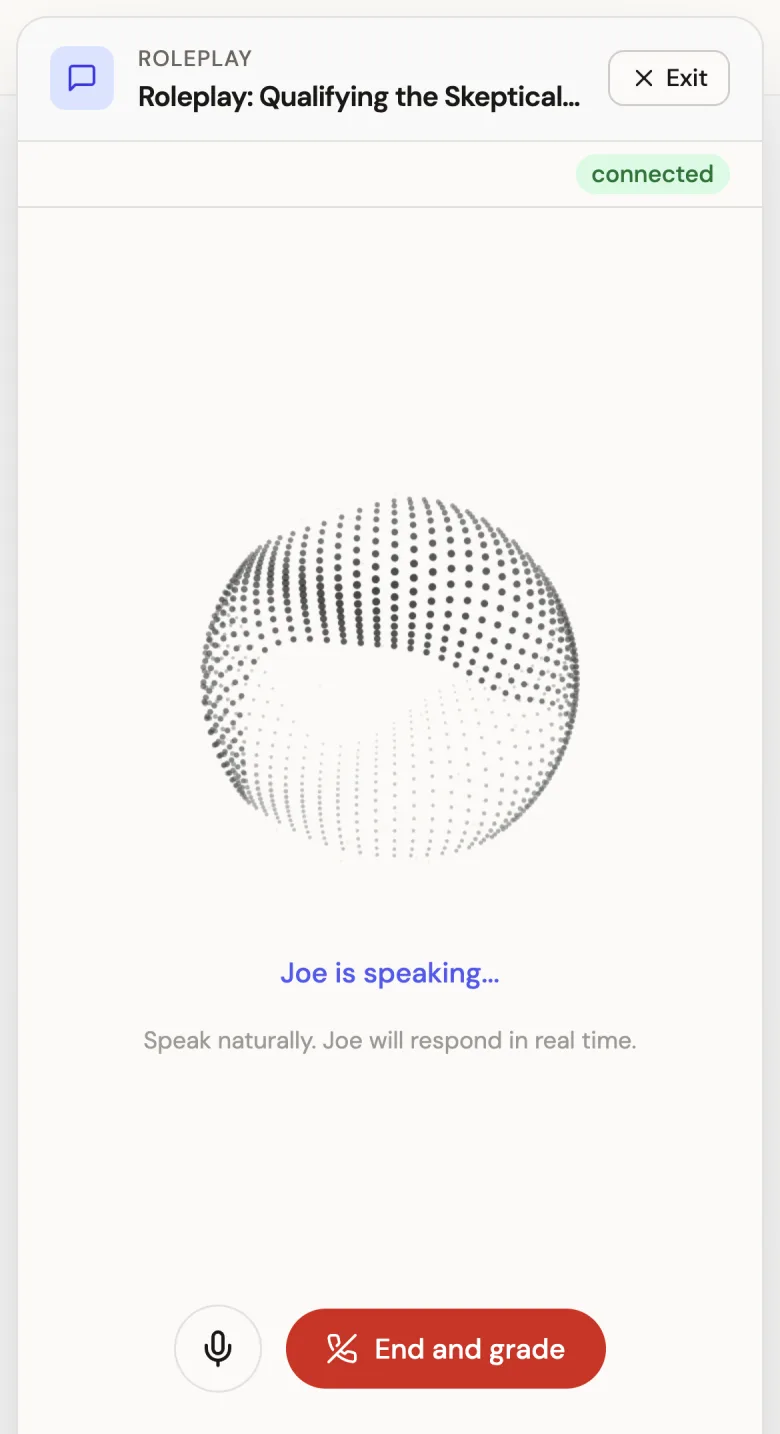

Most sales roleplay never happens, or doesn't sound like a real buyer.
Manager roleplays get cancelled.
Everyone agrees reps should practice. Then the week fills up, and the roleplay is the first meeting to go.
Generic AI buyers don't know your product.
A stock persona asks stock questions. Your buyers ask about your pricing, your competitor and the thing that went wrong last quarter.
Nobody scores the practice.
A colleague says “that was good.” You can't tell which reps can hold price and which ones only think they can.
How AI sales roleplay works in Mentor126.
Describe the call. Mentor126 builds the buyer.
Tell Mentor126 what to practice in plain language: a discovery call with an operations lead, a cold call opener, a CFO pushing on price, a buyer comparing you with a named competitor. It builds the persona and the rubric from your decks, product docs and call recordings, and follows your methodology (MEDDIC, SPIN or your own) when you attach it to the job role. Before the call, the rep sees the situation, who they're talking to, the objections coming and the weighted criteria they'll be graded on.
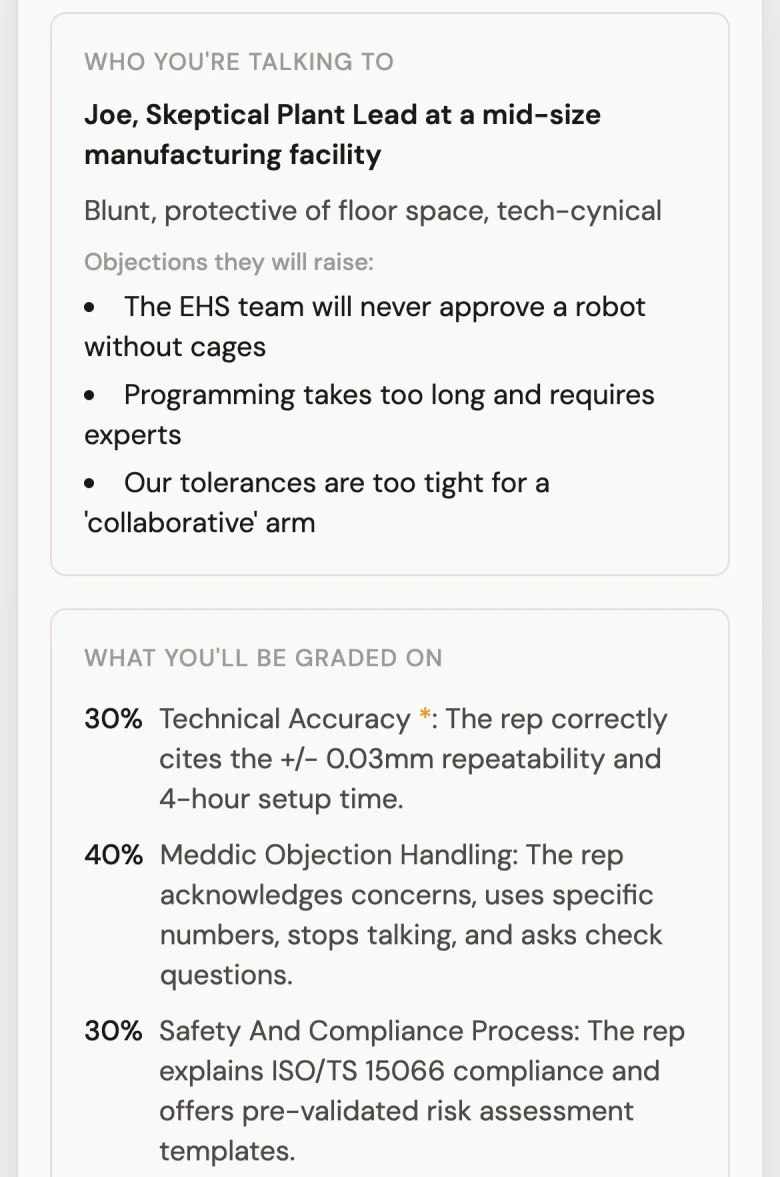

Built from your material
Persona, objections and rubric
A voice call that pushes back.
It's spoken, in the browser, on desktop or phone. The buyer interrupts vague answers, stacks objections and speaks up when the rep goes quiet. The buyer's temperament moves with the rep's results, from cooperative to adversarial, while the grading stays the same for everyone. Retries are unlimited and the best score counts.
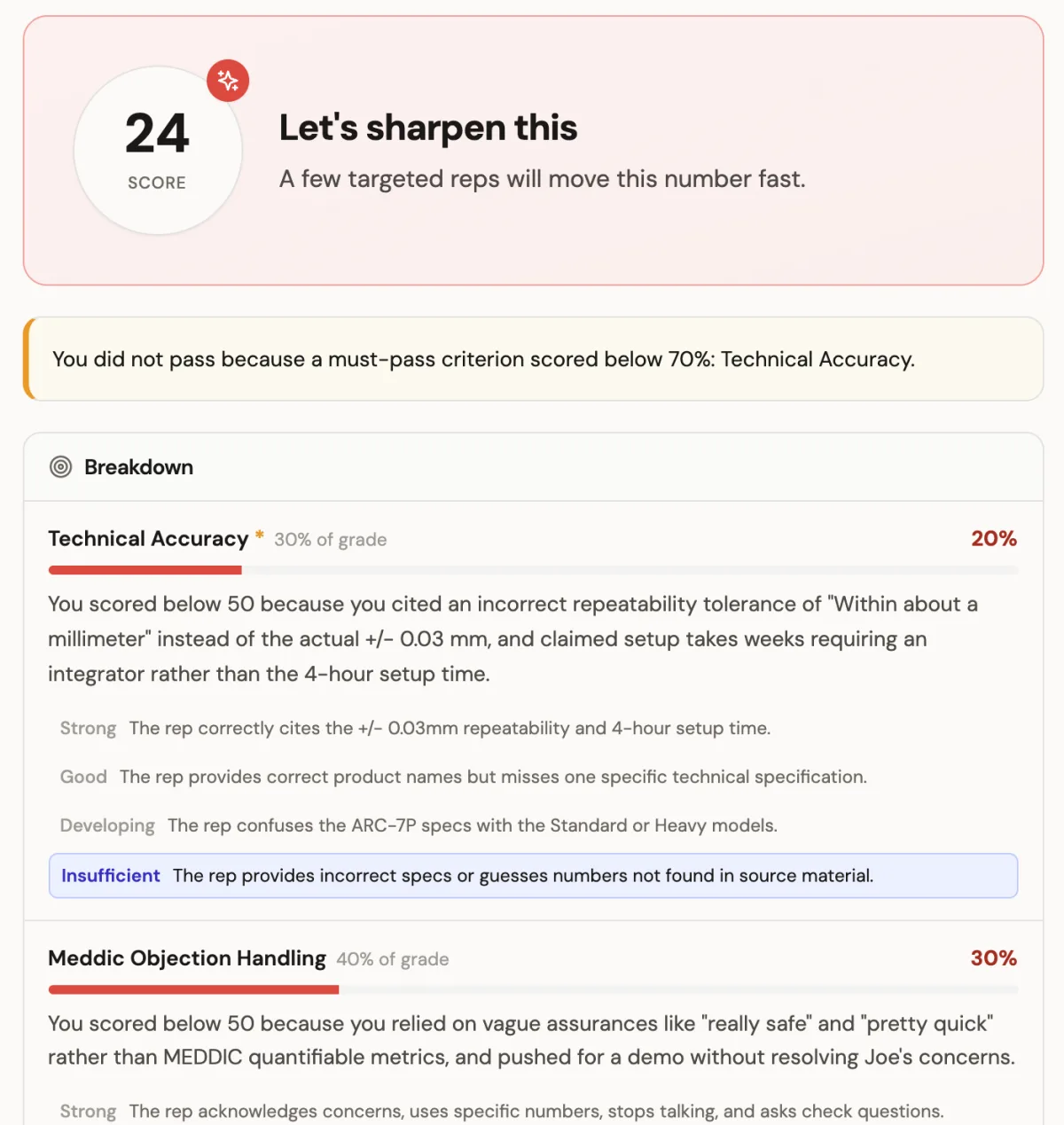
Gets tougher as they improve
The grading never gets easier
Graded on your criteria, quoting the rep.
Each call is scored criterion by criterion against a rubric written from your material, and every score comes with the reason and what the rep actually said. Missing a must-pass point fails the call. The pass mark is 70%, and the practice call only counts as done on a pass. Course results show which criteria the whole team misses, and on Team and Enterprise plans you can ask Mentor “who is weakest on pricing objections?” and get the chart back.
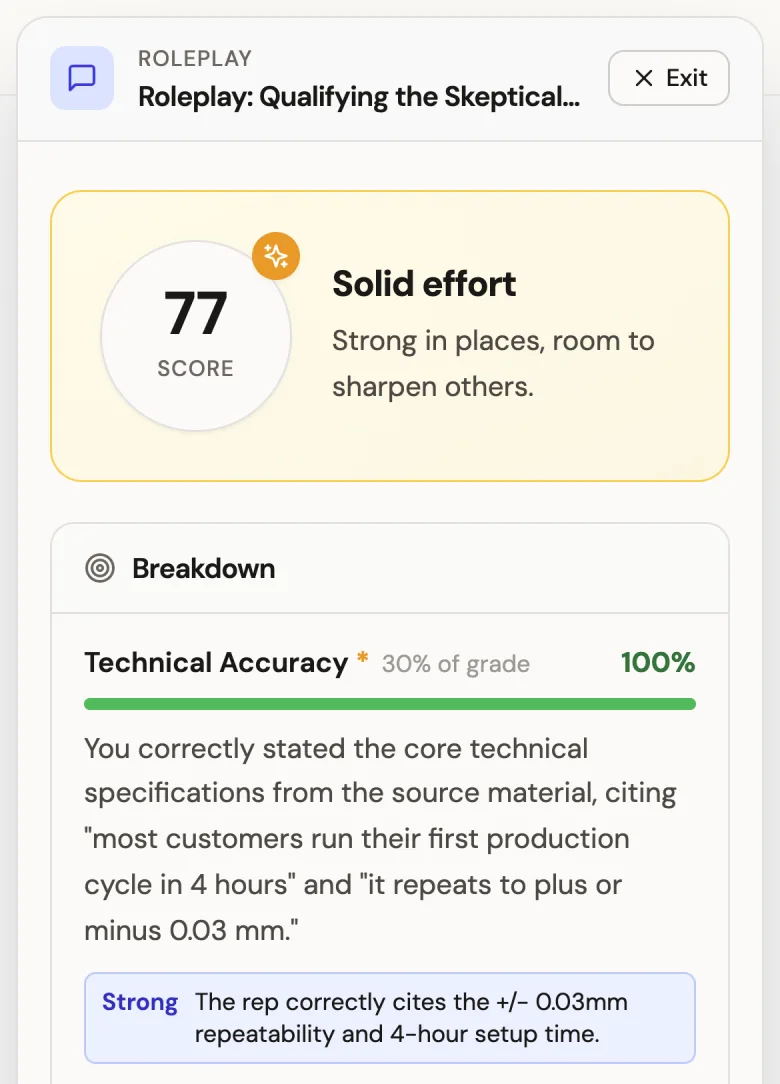

The rep's own words
Quoted as evidence for every criterion
What sales leaders ask
Any call you can describe and back with your material: discovery, cold call openers, demos with tough questions, pricing pushback, a named competitor, renewals, “not now.” For a full program on objections, see objection practice under use cases.
Most roleplay tools start from a stock persona that you configure. Mentor126 builds the buyer and the rubric from your own decks, docs and call recordings, and puts the roleplay inside a course, so reps learn the product first and then prove they can talk about it.
Voice. The rep speaks with the AI buyer in the browser, on desktop or phone.
Yes. The buyer's temperament moves with the rep's results, from cooperative to adversarial: a pass makes the next buyer tougher, a fail eases off. The rubric and the 70% pass mark are the same for every rep.
Yes. Creators run the roleplay themselves before publishing and can change the buyer or the rubric if it isn't right.
It doesn't have to. An LMS hosts and tracks content you build somewhere else. Mentor126 builds the sales training from your material, runs the spoken practice and scores it. Many teams keep their LMS for HR and company-wide training and use Mentor126 for their sales reps. There is no SCORM or LTI, so it runs beside an LMS, not inside it.
Starter is $35 and Team is $55 per seat per month, with a 15-day free trial for up to 25 users. For teams with 10 or more sales reps, we build your first course free and set the plan with you, and Enterprise is by quote.
Your reps practice the real conversation before it's real.
Get your reps' first course free, built from your website, docs and reviews. We walk you through it on a 30-minute call.
Get your free courseFree for teams with 5+ reps. No credit card.