An LMS stores training and records who finished it. Mentor126 builds the sales course from your own material, has reps practice the conversation out loud, and tells you who can actually hold it.
If you run a sales team, you probably already have an LMS somewhere in the company. HR uses it for policies, IT for security training, and at some point someone uploaded a product overview for new reps. The question is not whether the LMS is bad. It is whether it is the right tool for getting a new rep ready to carry a number. This page lays out the difference plainly, including where an LMS is the better choice.
A typical LMS
Mentor126
Where the course comes from
Someone builds it in an authoring tool or buys a library, then uploads it.
Built from your website, decks, product sheets and call recordings, in 13 formats. Flags conflicts and facts it couldn't find in your sources.
Read, listen, and practice discovery and objections out loud with an AI mentor playing the buyer.
What counts as done
A typical LMS
Completion: the module was opened and the quiz was passed.
Mentor126
A passing score on a rubric built from your material. Only a pass completes an assessment.
What managers see
A typical LMS
Completion rates and quiz scores.
Mentor126
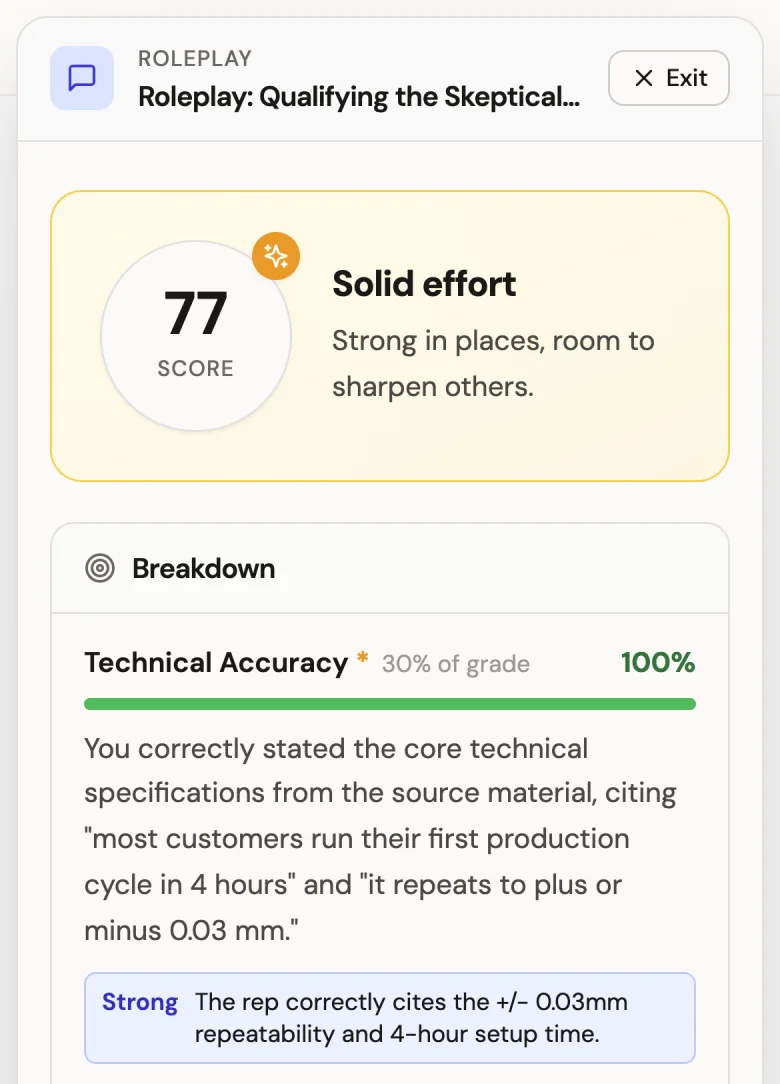
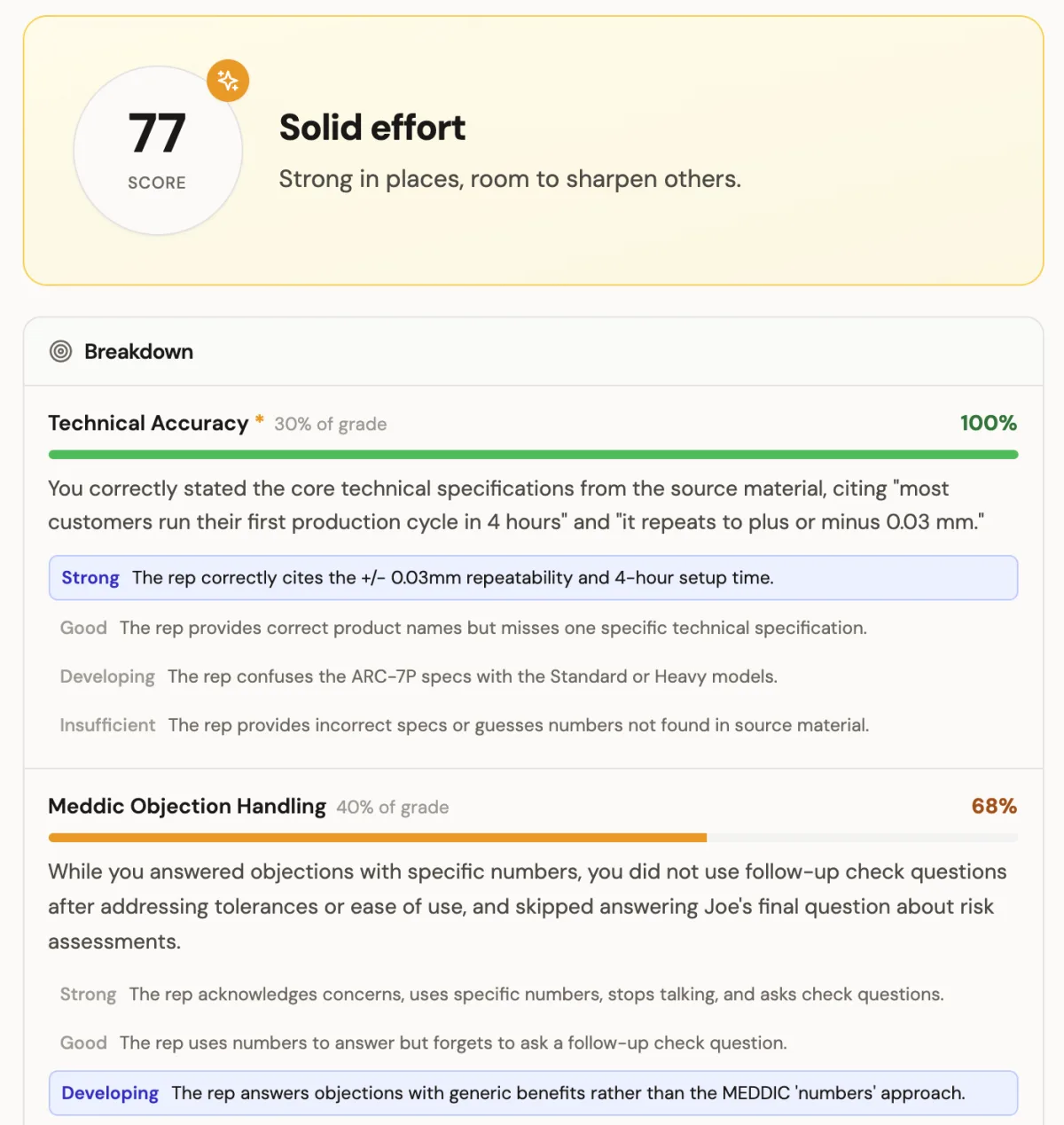
Scores per skill on each practice call, with the rep's own words as evidence, and the skills the team misses most.
Your methodology
A typical LMS
Lives in a PDF in the course, if anyone uploaded it.
Mentor126
Attached to the sales role, so practice scenarios and grading follow it.
When the product changes
A typical LMS
Someone rebuilds the module.
Mentor126
Tell Mentor what changed and it makes a new version of the lesson. Conflicts between documents are flagged.
Best at
A typical LMS
HR policy, security awareness, a catalog across the whole company.
Mentor126
Getting new sales reps able to hold the conversation, and showing who is ready.
What an LMS is built to do
A learning management system is a library with a register. You load courses into it, assign them to people, set due dates, and it tells you who finished what. That is exactly what you want for mandatory company-wide training, where the question is whether every employee completed the module this year. It is also good at running a catalog across a whole company, from security awareness to manager training.
What an LMS does not do is make the course. Someone has to write it, record it or buy it, usually in a separate authoring tool, and then keep it current every time the product, the pricing or the pitch changes. And what it measures is completion. A rep who opened every module and scraped through the multiple-choice quiz looks the same on the dashboard as a rep who could explain your pricing to a hostile CFO.
Why sales onboarding is a different problem
Sales is a spoken, live skill. The moment that matters is a buyer saying the price is too high, or that they tried something like this before and it failed, and the rep having a few seconds to answer. Recognizing the right answer in a list is not the same as producing it out loud under pressure, which is why so many reps who pass onboarding still freeze on their first real objection.
So the test for a sales onboarding tool is different. Can it teach your product, in your words? Can reps practice the actual conversation before they have it with a customer? And can you, as the sales leader, see who is ready without sitting in on every call?
How Mentor126 approaches it
Mentor126 starts from the material you already have. Give it your website, your sales deck, product sheets and a few call recordings, and it builds the course: readings, flashcards, quizzes, podcasts, scenarios, case studies and practice calls. Anything it couldn't find in your sources is flagged for you to check, and when two of your documents disagree, it flags the conflict rather than picking one.
Reps then practice the conversation out loud with an AI mentor playing the buyer. Before they start, they see the situation, the buyer, the objections coming and the criteria they will be graded on. Attach your methodology, MEDDIC, SPIN or your own, to the sales role, and the scenarios and grading follow it. Each call is scored criterion by criterion against a rubric built from your material, and an assessment only completes on a passing score.
For you, that means a different kind of report. Not who finished the module, but who can handle the technical questions, who holds price, and who still needs work before they get a territory. You can also ask questions in plain English, like who is weakest on pricing objections, and get the chart back.
When you want both
For most companies the answer is not either-or. Keep the LMS for what it is good at: HR policy, mandatory training and the company-wide catalog. Use Mentor126 for sales onboarding and ongoing practice, where the goal is a rep who can hold the conversation. The two don't compete for the same job.
If you are a smaller team without an LMS, Mentor126 assigns courses to roles, sets deadlines and reports progress, so for sales training you don't need to buy one first.
How to decide
Ask what you need to know at the end of onboarding. If the answer is that everyone completed the required modules, an LMS does that well. If the answer is which new reps can run a discovery call and handle your top objections, you need practice and scoring, and that is what Mentor126 is built for.
The quickest way to judge is to see it on your own product. Book a demo and we will show you Mentor126 on your own material, on a 30-minute call.
Frequently asked questions
Is Mentor126 an LMS?
Not in the usual sense. It doesn't host a catalog of courses built elsewhere. It builds the course from your own material, runs practice with an AI mentor, and scores it against a rubric. It does assign courses to roles, set deadlines and report progress, so for a sales team it can be the only training tool you need.
Can we use Mentor126 alongside our LMS?
Yes, and many teams do. Keep the LMS for HR and company-wide training. Use Mentor126 for sales onboarding, where the goal is a rep who can hold a real conversation rather than a completed module.
Do we need an instructional designer to use it?
No. Mentor126 builds the course from your sources and proposes the lessons. You review it, ask for changes in plain language, and publish. On a demo, we build it from your own material before the call.
How does Mentor126 score a practice call?
Each practice call has a rubric written from your material, with weighted criteria the rep sees before starting. The score is added up from the criterion scores, and each one comes back with the reason and the rep's own words.
What does it cost compared to an LMS?
Starter is $35 and Team is $55 per seat per month, with learning credits included and a 15-day free trial for up to 25 users. Enterprise is by quote. Teams with 10 or more sales reps can book a demo and see it on their own material first.
Your reps practice every sales conversation before it's real.
See Mentor126 on your own material, on a 30-minute call.